About Medical Home
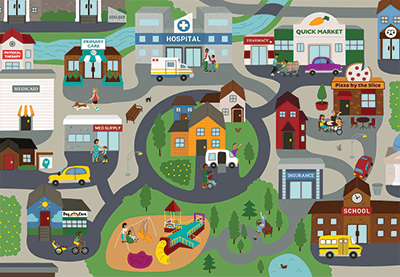
A medical home is not a house, office, or hospital, but rather an approach to providing comprehensive primary care. In a medical home, a primary care clinician and her/his team work as a team with the family/patient to make sure that the medical and non-medical needs of the child/youth are met. The clinical team can help the family/patient find and arrange specialty care, school services, out-of-home care, family support, and other public and private services that are vital to the total health and well-being of the child and family.
- Accessible
- Continuous
- Comprehensive
- Family-centered
- Coordinated
- Compassionate
- Culturally effective care
Though many uses of the medical home model focus on children and youth with special health care needs (CYSHCN), "every child deserves a Medical Home." AAP Policy Statements ([American: 2004], [Rushton: 2005], [Cooley: 2004], [Council: 2005]) have recognized the role of pediatricians and other primary care clinicians in providing comprehensive care for children with chronic and complex conditions and defined the medical home concept.
Who are Children and Youth with Special Health Care Needs?
Children and Youth with Special Health Care Needs (CYSHCN) are "those who have or are at increased risk for a chronic physical, developmental, behavioral, or emotional condition and who also require health and related services of a type or amount beyond that required by children generally." [McPherson: 1998] Studies have found the prevalence of children in the United States meeting these criteria to be 12.8% [van: 2004] to 15.6% [Newacheck: 2005]. The National Survey of Children with Special Health Care Needs 2017/2018 found 18.5% of the nation's children met this definition of children with special health care needs. More information about the study and data from each state is at Data Resource Center for Child & Adolescent Health.
Title V Funding
Title V funding comes federally from the Health Resources and Services Administration (HRSA) and the Maternal and Child Health Bureau (MCHB). Everystate receives Title V Funding based on their population. Find out more about your state's Title V organization: State Title V Snapshots.
This funding allows states to:
- Assure access to quality health care services.
- Reduce infant mortality.
- Increase regular screenings and follow-up diagnostic care.
- Services for CSHCN.
- Coordinated care for CSHCN.
- Medicaid application assistance through toll-free hotlines.
For More Detailed Information:
Information about the medical home concept and related topics is available at the National Center for Medical Home Implementation, sponsored by the American Academy of Pediatrics. The site offers useful information about national and local resources linked to medical home and CYSHCN.
The mission of the Center for Medical Home Improvement is to set up and support networks of parent/professional teams to improve the quality of primary care medical homes for children and youth with special health care needs and their families. Useful tools and resources are available on their web site.
Resources
Information & Support
For Professionals
For Parents and Patients
Family Voices
A national, nonprofit, family-led organization promoting quality health care for all children and youth, particularly those
with special health care needs. Locate your Family-to-Family Health Information Center by state.
For Families and Caregivers (AAP)
Provides information for families as well as tools and resources that are helpful for parents and caregivers of children with
special health care needs; American Academy of Pediatrics.
Page Bibliography
American Academy of Pediatrics Medical Home Initiatives for Children With Special Needs Project Advisory Committee.
Policy statement: the Medical Home.
Pediatrics.
2004;113(5 Suppl):1545-7.
PubMed abstract / Full Text
Cooley WC.
Providing a primary care medical home for children and youth with cerebral palsy.
Pediatrics.
2004;114(4):1106-13.
PubMed abstract / Full Text
Council on Children with Disabilities.
Care coordination in the medical home: integrating health and related systems of care for children with special health care
needs.
Pediatrics.
2005;116(5):1238-44.
PubMed abstract / Full Text
AAP policy that helps primary care clinicians connect children and their families with appropriate services and resources
in a coordinated effort to achieve good health.
McPherson M, Arango P, Fox H, Lauver C, McManus M, Newacheck PW, Perrin JM, Shonkoff JP, Strickland B.
A new definition of children with special health care needs.
Pediatrics.
1998;102(1 Pt 1):137-40.
PubMed abstract
Newacheck PW, Kim SE.
A national profile of health care utilization and expenditures for children with special health care needs.
Arch Pediatr Adolesc Med.
2005;159(1):10-7.
PubMed abstract
Rushton FE Jr.
The pediatrician's role in community pediatrics.
Pediatrics.
2005;115(4):1092-4.
PubMed abstract / Full Text
van Dyck PC, Kogan MD, McPherson MG, Weissman GR, Newacheck PW.
Prevalence and characteristics of children with special health care needs.
Arch Pediatr Adolesc Med.
2004;158(9):884-90.
PubMed abstract